


The Dentistry Huddle Delivered.
From us to your inbox, twice a month.
Key Takeaways
- Your cost to collect is the real scale test. Rather than watching aged A/R buckets, track whether collection spend stays flat as a percentage of net production as your organization grows. Of that ratio climbs, you're growing expenses alongside revenue, not actually scaling.
- Patients are now a primary payer. Time to evaluate any manual workflows. With patients owing over 40% of A/R balances, front-desk teams can't manually call and prioritize thousands of accounts each week, driving the burnout and inconsistent processes that many billing leaders cite as a top challenge.
- Four process metrics expose hidden failure points: touch points to payment (50% of Imagen's payments come after just one Pearly text), speed to cash (automation collects while manual processes wait on staff capacity), percentage of "dark A/R" blocked by bad contact info, and isolating the patient-only portion of 90+ day A/R as a leading indicator of bad debt.
If you're leading a Revenue Cycle Management (RCM) team for a growing DSO, you probably already feel the ground shifting beneath your feet. The old ways of doing things simply aren't working anymore. The reality is that the dental landscape has completely changed over the last year and a half, and the playbook we used to use to collect money needs a serious rewrite.
During the recent Becker’s Dental & DSO-hosted webinar, "The Multi-Location A/R Framework: Grow Revenue, Not Your Back Office," Sam Champagnie, the VP of Revenue Cycle Management at Imagen Dental Partners and a Pearly customer, broke down exactly how she is rewriting that playbook for 130 practices across 17 states.
Sam provides a masterclass on how to diagnose the health of an RCM department, unblock trapped revenue, and truly scale.
Let’s break down exactly what she shared, why traditional metrics are failing you, and the specific numbers you need to start tracking tomorrow.
The Modern RCM Challenge: Patients Are the New Payers
Before we can fix the machine, we need to understand why it’s breaking down. Historically, dental billing was largely an insurance game. But today? The burden has shifted heavily to the patient. According to Sam and other peer RCM experts, patients owe more than 40% of AR balances today. They’re their own payer with almost half of the payer mix is patient A/R, patient portion responsibility.
This creates a massive operational headache. As Sam bluntly explained to the webinar audience, the math simply doesn't work for growing DSOs:
"The friction is in the fact that it doesn't scale. It creates capacity constraints; it creates burnout. A front office team can't call 5,000 patients a week. A front office team can't prioritize which of those 5,000 patients need to be contacted."
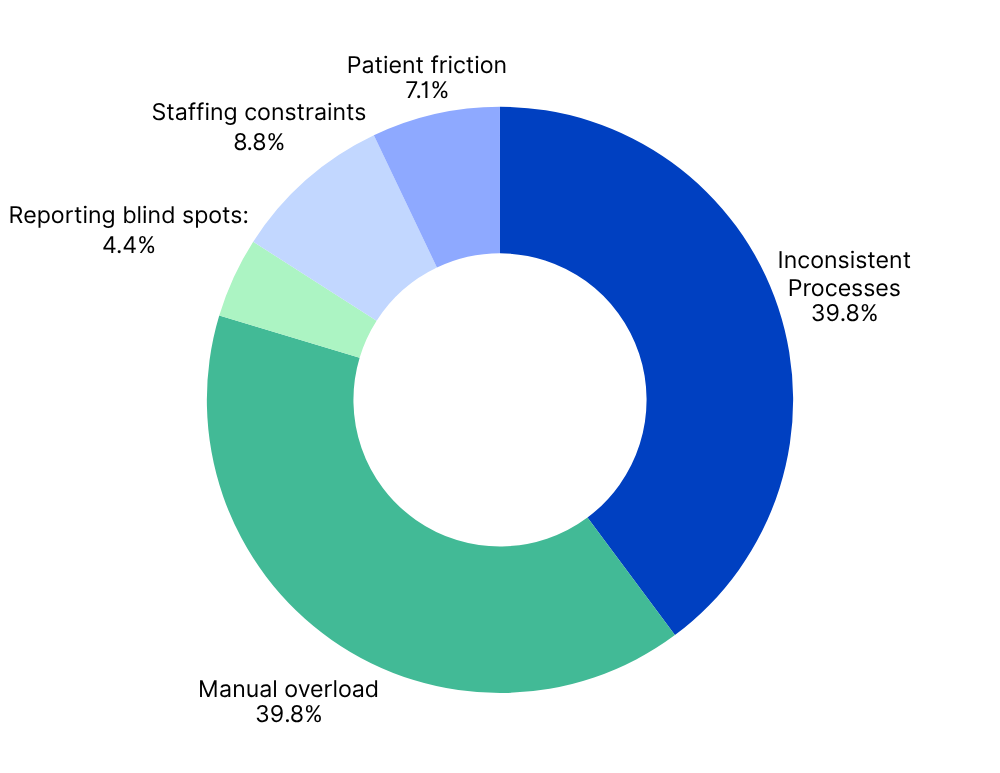
If you're feeling this friction, you’re not alone. According to our webinar poll, 40% of attendees indicated that inconsistent processes (i.e. billing workflows and patient communication varies too much) is their biggest challenge when it comes to patient A/R. Another 40% indicated that manual overload is their biggest challenge. This includes teams spending too much time manually chasing payments with calls, mailing, batch texts etc.
And here’s the real kicker: this isn't just about cash flow; it’s about patient and partner happiness.
Sam shared a brilliant insight during the discussion:
One of the interesting statistics that I came across recently is that a survey of dentists in DSOs indicated that RCM, in their mind, was the biggest lever to patient satisfaction: the ability to collect on that dentistry. That I thought was a very telling statistic, because I don't think we think about it that way in terms of partner satisfaction, which is so critical to a DSO/DPO model.
To fix this, we have to look at our data differently.
The "North Star" Outcome Metric: Why Cost to Collect is King
Most RCM leaders measure their success by looking at how much of their outstanding A/R is sitting past 90 days. But as Sam points out, that’s just an outcome. It tells you what happened, but it doesn't tell you why it happened or how to fix it.
To determine if her massive RCM machine is genuinely working, Sam watches one primary “outcome metric” like a hawk: her cost to collect.
To understand how this impacts scalability, she asks herself:
Is the percentage of my spend as a percentage of my net production increasing? Is it staying flat as I grow? That is the definition of scale, so that is my measure of whether or not I'm scaling.
Think about that for a second. If you add 10 new practices to your DSO this year, but you have to hire five new billing specialists to handle the increased patient balances, you aren't scaling. You're just growing your expenses alongside your revenue. True scale means your production and patient base can multiply while your administrative headcount stays exactly the same.
The 4 Process Metrics: Finding the Leaks in Your RCM Machine
So, how do you keep that cost to collect completely flat? You monitor what Sam calls “process metrics.” These process metrics tell her if she’s going to hit that outcome metric-i.e. are they going to scale or not?
Instead of just looking at aged balances, Sam digs into the mechanics of the collection continuum to find failure points before they become bad debt. Here are the four metrics she tracks:
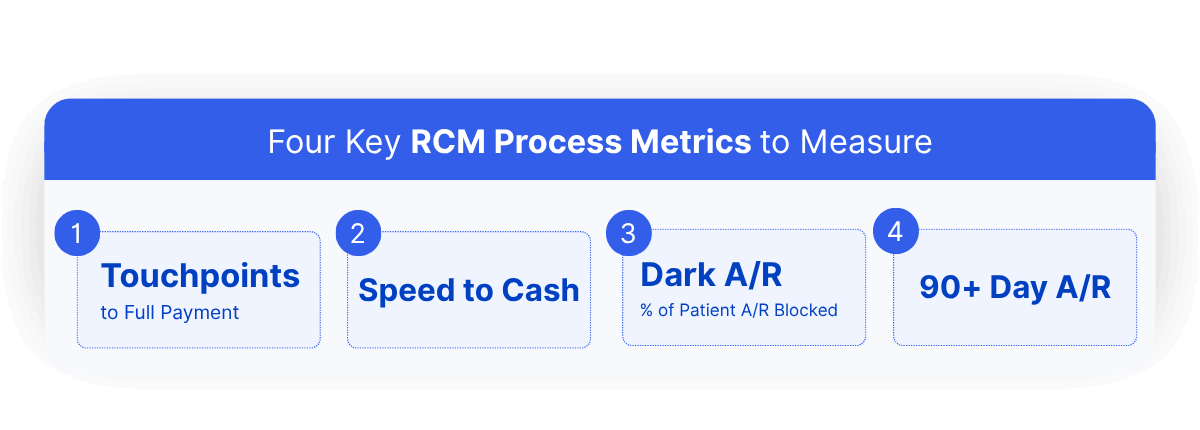
- Touchpoints to Payment - This metric measures sheer effectiveness. According to Sam, “How many times do I have to reach that patient before they actually turn around, respond to me, and pay their bill? And I'm talking about full payment, not partial payment.”If your team is making four phone calls and mailing three paper statements just to collect $150, your process is fundamentally broken. By automating outreach through Pearly, Sam revolutionized this metric at Imagen. Today, 50% of Imagen’s patient payments are received after just one text with Pearly. More than 67% of them are resolved after three texts.
- Speed to Cash - This metric asks a simple question: How many days were patients in that billing engagement process? In a DSO environment, that time is literally money. DSOs need to fund their growth without spending money on new capital, so speed to cash becomes very important.
When you rely on a manual process, that dollar has to wait for someone at the front desk to have the capacity and time to prioritize it. Automated outreach, however, happens in seconds, driving funds directly into your bank account while your team sleeps. - Percentage of Patient A/R Blocked (AKA "Dark A/R") - This is perhaps the most eye-opening metric here. It measures what percentage of your A/R is sitting there and not being addressed because of outdated contact info, friends of the doctor, etc.
They aren't getting statements at all, meaning they don't even know they owe a balance. Before using Pearly, Imagen Dental Partners had no visibility into this because local manual processes masked the problem.
Using Pearly as a diagnostic tool, Imagen found that over 20% of their patient A/R was being blocked. Shining giant spotlight on these hidden balances allowed the organization to improve data hygiene and correct front-desk avoidance behaviors. - 90-Day Patient A/R - While this shouldn't be your only metric, it still remains incredibly important. This metric can be tracked as a leading indicator for bad debt. However, notice the distinction: Sam from Imagen isolates the patient portion over 90 days, not just the total A/R over 90 days. By keeping a close eye on this segment, she can diagnose exactly why those dollars are sitting uncollected and deploy targeted strategies to save them before they are written off entirely.
The Blueprint for Scaling Your Dental Organization
If we're going to pull some mentorship wisdom from Sam's playbook, it boils down to this: you cannot scale a manual patient collection process.
As long as you’re relying on human beings to lick stamps, stuff envelopes, and awkwardly ask patients for money over the phone, your cost to collect will inevitably rise right alongside your practice growth.
To be a forward-thinking RCM leader, you must standardize your workflows across all locations and layer intelligent automation on top of them. You need to look beyond the surface of your 90-day aging buckets and start analyzing your touchpoints, your speed to cash, and your invisible dark A/R.
Pearly was built specifically for this. Pearly is a patient billing and A/R management platform that has helped thousands of practices and DSOs streamline RCM operations and accelerate cash flow. It takes the manual burden off your front desk, communicates with patients exactly how they want, and gives you the concrete metrics you need to prove to your team that your department is truly scaling. Schedule a call with our team to learn more about our billing solutions.
