
Access the calculator here:
Staff Time Calculator

See where your front office hours really go.
Patient billing is quiet, constant work. Between sending statements, making collection calls, posting payments, and auditing accounts, the time adds up. Unfortunately, it rarely shows up on anyone's radar until it's too late.
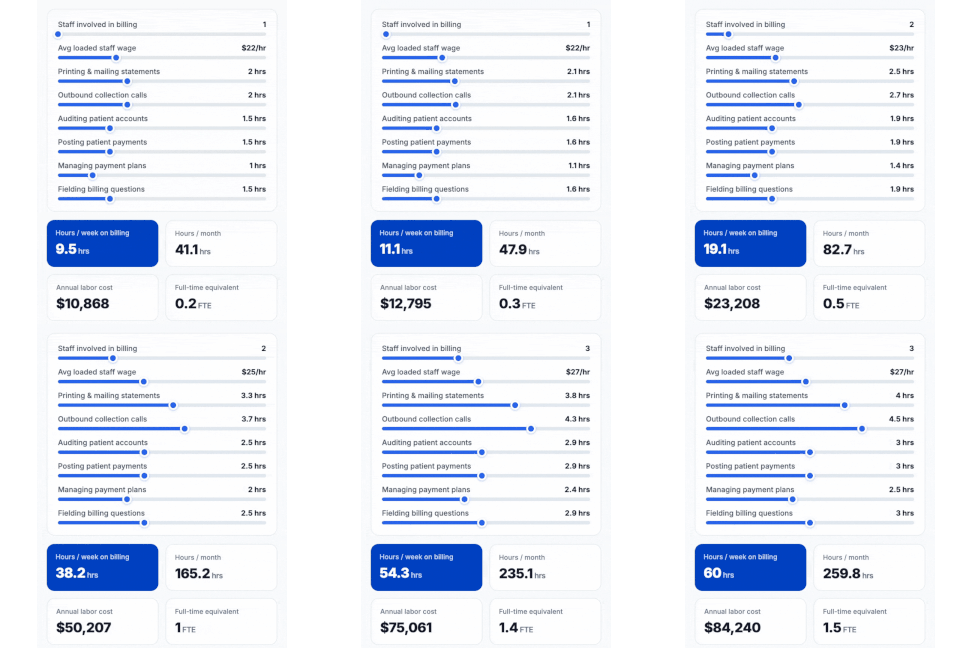
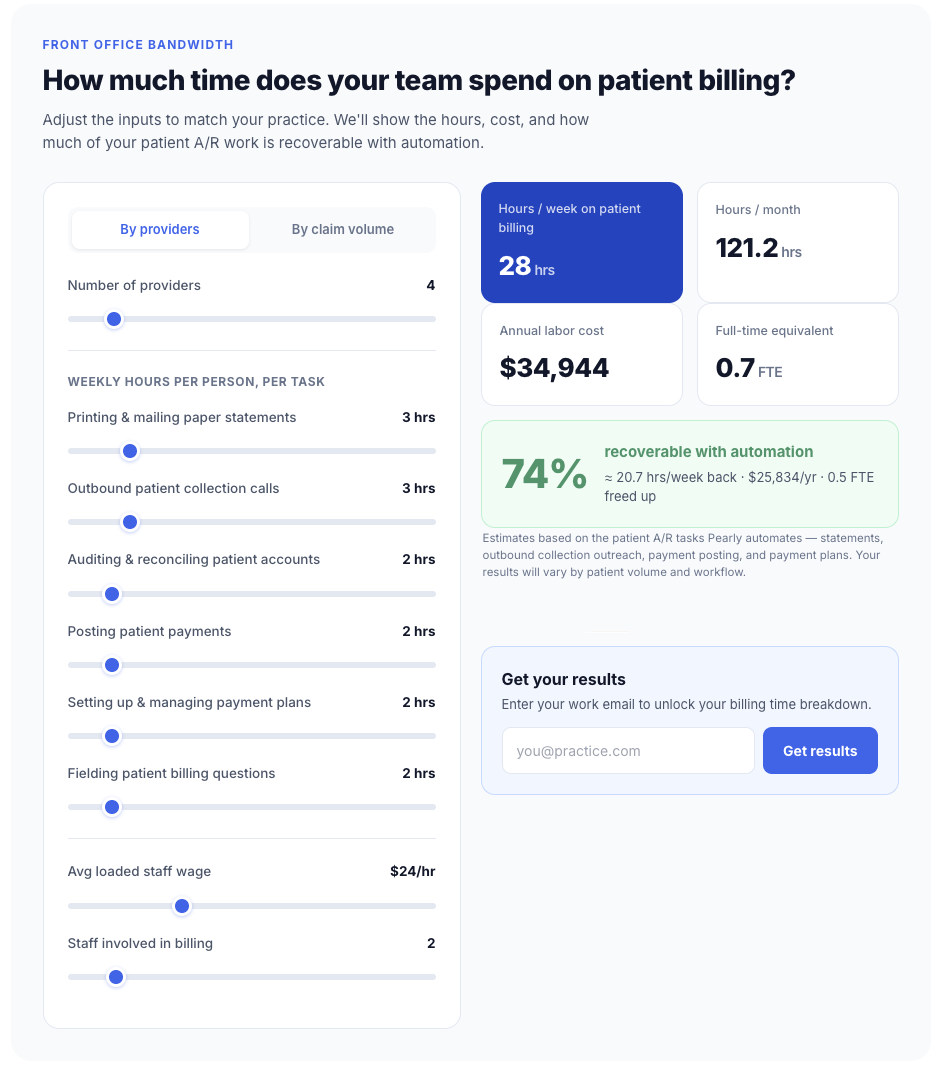
This calculator turns those scattered tasks into real numbers: hours per week, annual labor cost, and full-time-equivalent staff. Adjust the inputs to match your practice and see what your team's billing workload actually costs.
Complete the form to get instant access to the calculator.
Practices and DSOs that understand how their office hours are being spent are better equipped to position their staff for practice-scaling initiatives. If you are looking to improve practice profitability through cash flow management, you can scheduled a call with our RCM experts.
Find out if Pearly is right for your practice.
Book a 1:1 demo with a product expert.
Schedule Free Demo 
Why billing time is so hard to see
Patient billing rarely shows up as a line item on its own. Instead, it's spread across a dozen small tasks that happen throughout the week: printing and mailing statements, making collection calls, posting payments, reconciling what's been paid against what's owed, fielding billing questions at the front desk, and periodically auditing accounts that seem stuck. None of it looks like much in isolation, but added up across a month, it's often one of the largest hidden labor costs in a dental practice.
The reason it stays invisible is that it's rarely anyone's full-time job. It gets absorbed into front-office hours alongside scheduling, check-in, and insurance verification. This means practices routinely underestimate how much staff capacity billing actually consumes, and how much of that capacity automation could free up for higher-value work.
What goes into the calculation
This calculator converts the scattered tasks above into three concrete numbers: hours spent per week, the annual labor cost of that time, and the full-time-equivalent (FTE) staff it represents. It accounts for the recurring billing tasks most dental practices handle in-house, including statement generation, collection follow-up calls, payment posting, and account auditing. It is then weighted by how frequently each task typically occurs and how long it takes per patient account.
You can adjust every input to match your own practice: patient volume, average hourly billing labor cost, and how much of each task your team currently does manually versus with existing tools. The result is a practice-specific estimate, not a generic industry average.


