


The Dentistry Huddle Delivered.
From us to your inbox, twice a month.
The front office is where revenue cycle management succeeds or fails. The same team members who greet patients, verify insurance, and ultimately (yet unfortunately) chase down balances are also the ones most likely to burn out, disengage, and walk out the door. They take institutional knowledge and bandwidth to recover uncollected A/R with them. For DSOs and group practices, front office turnover isn't just an HR headache; it's a direct hit to collected revenue.
Here's the insight that ties it all together: the levers that retain front office staff are largely the same ones that improve collections. Take the busywork off their plate, give them clear systems and training, and you lift morale and net collection rate at the same time. This guide pulls together our best resources on doing both. Let’s get organized around the three pillars of a high-performing front office: staff, systems, and training.
Start Here: The Three Pillars of Collections Excellence
Before diving into individual tactics, it helps to see the whole picture. In our on-demand webinar with Dental Economics, featuring Editor-in-Chief Dr. Pamela Maragliano-Muniz and Pearly CEO Jeff Cole, we make the case that getting paid for what you produce comes down to aligning three things: your staff, your systems, and your training. Growing A/R balances, rising write-offs, and staff turnover are all symptoms of the same root problem, and the webinar lays out how to benchmark your A/R metrics and boost your collection rate in as little as 30 days.
→ Watch: How to Achieve Collections Excellence by Aligning Staff, Systems, and Training

Pillar 1: Take the Manual Busywork Off Their Plate
Front office staff rarely leave because the work is hard, they leave because too much of it is tedious, repetitive, and avoidable. Manually batching statements, mailing paper reminders, and dreading the monthly round of collection calls are the tasks that drain morale fastest. And they're expensive.
We ran the numbers on exactly how expensive. Our cost analysis models a typical practice and walks line by line through the material, labor, and opportunity costs of a manual billing process. We land on a figure of roughly $11,000 a year in pure billing overhead, before you even account for the collections lost to a sub-par collection rate. Every hour your office manager spends on collection calls is an hour not spent on patients, growth, or the higher-value work that makes a job worth staying in.
→ Read: How Much Is Patient Billing Costing Your Practice?

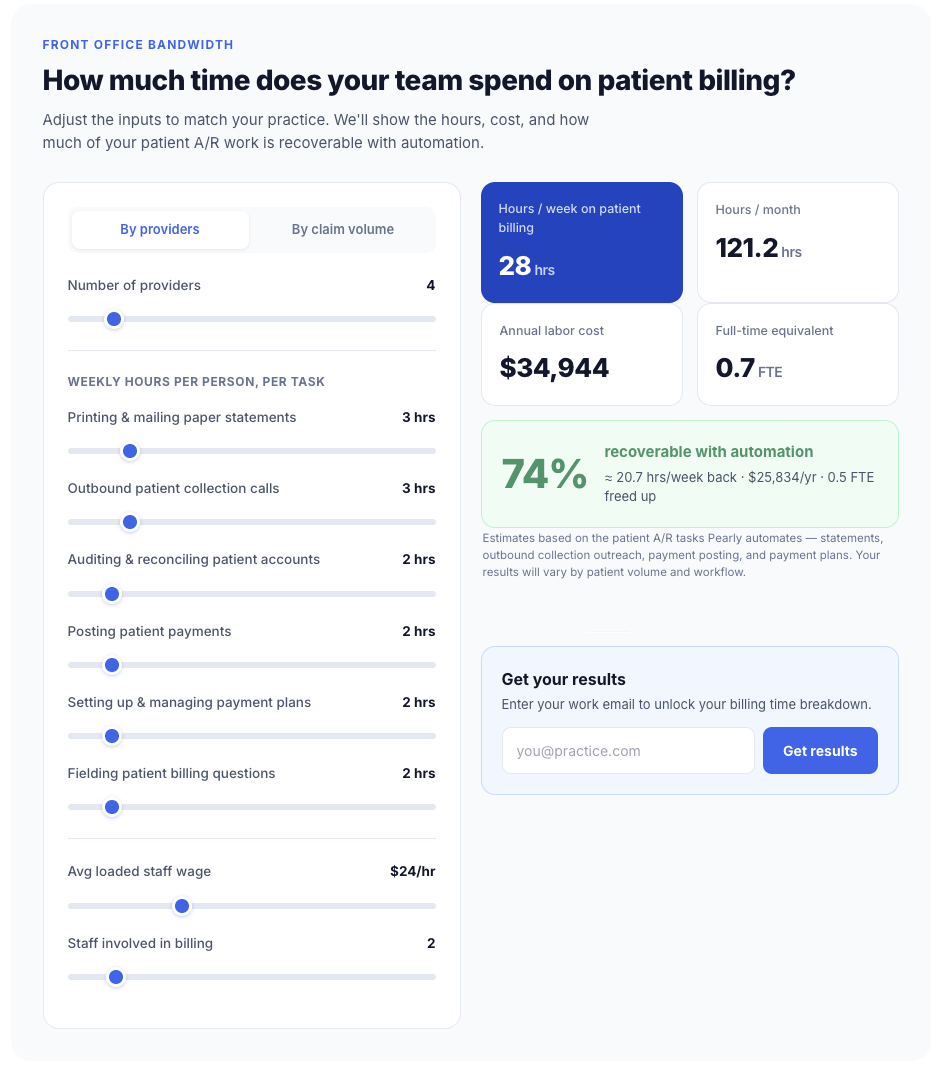
The Staff Time Calculator
Plug in your patient volume, statement cadence, and staff hourly rates to see exactly how many hours your front office is spending on manual billing each month, and what those hours are worth back if you automate them. Use it as the bridge between "this feels like a lot of busywork" and a hard number you can take to leadership.
Access the calculator here.
Pillar 2: Give Them Better Systems (and Ask Better Questions)
You can't fix what you haven't diagnosed. Empowering your team starts with taking an honest look at how billing actually runs today: How often are statements going out? Across how many channels? How much time is being spent tracking down each balance? Are you batching statements once a month and missing timing windows, or sending on a rolling, automated schedule?
Our list of efficiency questions gives office managers and RCM leaders a ready-made audit: eleven prompts designed to surface the gaps where staff time leaks and collections slip. It's a practical starting point for any team that suspects its billing process has quietly accumulated inefficiencies, and it doubles as a framework for standardizing the process across multiple locations so neither staff nor patients get an inconsistent experience.
→ Read: 11 Efficiency Questions for RCM and Billing Staff

Pillar 3: Train for Confidence and Career Growth
Systems only go so far without people who know how to use them. RCM training is one of the most underrated retention levers a practice has: it turns staff into versatile, confident specialists who can handle insurance complexity, stay on top of aging A/R, and navigate patient financial conversations without dread. It also makes onboarding far smoother. When a trained team member leaves, a well-documented training program means the transition doesn't tank your collections.
Our deep dive on RCM training breaks down the trifecta of benefits: operational efficiency, regulatory compliance, and a better patient experience. Critically, investing in your team's skills signals that you're offering a career, not just a job. This switch is exactly the kind of growth opportunity that keeps people from answering the next recruiter's call.
→ Read: The Importance of RCM Training

Zoom Out: Why Retention Is the Whole Game Right Now
None of this happens in a vacuum. The dental industry is in the middle of a sustained labor shortage. Two-thirds of practices name staffing as their top challenge, and the talent gap is projected to widen for years. That backdrop raises the stakes on everything above: when hiring is hard and expensive, keeping and empowering the staff you already have becomes the single highest-leverage move you can make.
Our guide to overcoming dental staffing challenges lays out tested strategies for both sides of the equation, which is attracting talent and retaining it. A recurring theme: automating the repetitive, training-heavy work (like RCM) expands your existing team's bandwidth, eases the pressure to over-hire, and helps build the kind of fulfilling environment that an ADA survey of 9,000+ professionals identified as a top driver of whether staff stay or go.
→ Read: 7 Tested Strategies for Overcoming Dental Staffing Challenges

Proof It Works: Catalyst Dental Allies (Case Study)
This isn't just theory. Catalyst Dental Allies, a 47-office Oklahoma DSO, was dissatisfied with their collection results, their patient experience, and the sheer amount of staff time their billing process consumed. By automating their patient billing with Pearly and targeting only fully-eligible balances, they freed their RCM team from manual account auditing and statement sending.
The result was a win on both fronts of this guide: a 29% boost in collection performance in under four months and 9 hours of staff time saved per office, per week—lifting staff and collected A/R, exactly as the theme promises.
→ Read: How Catalyst Dental Allies Enhanced Collection Performance by 29%

Bringing It Together
Front office empowerment isn't a soft, feel-good initiative separate from your financial goals—it's one of the most direct paths to improving collected A/R. Remove the manual busywork, give your team better systems and the right questions to ask, train them for confidence and career growth, and you'll lift both retention and collections at once.
Start by quantifying the opportunity with the Staff Time Calculator above, then work through the resources linked throughout this guide to put each pillar into practice.
→ See how Pearly empowers your front office—book a 1:1 demo.
